
Why One Study Is Almost Never Enough
Scientific headlines often hinge on a single study, promising clear answers. But individual studies are designed to answer narrow questions, not deliver universal truths. An exploration of why replication matters, how evidence accumulates, and how to read new research more carefully.

The appeal of a single answer
Scientific headlines often hinge on a single study: ‘New study shows that X results in Y.’ The framing is appealing because it signals clarity. In a world flooded with information, a single result feels efficient and reassuring—it offers the comfort of a definitive answer. But that comfort is misleading. Science doesn’t operate on one-offs. It depends on repetition, revision, and accumulation. A single study is rarely the end of a conversation. More often, it’s the beginning.
What a study is designed to do
An individual study is designed to answer a specific question under controlled conditions. It uses a particular population, a particular methodology, and measures a particular outcome. These constraints are essential for interpretation; without a clearly and narrowly defined process, results would be difficult to interpret.
But those same constraints are why every study has limitations. Findings only apply to that population, under that methodology, in that context. Even when results are statistically significant, they still represent a single observation made under one set of conditions at one moment in time. A study is meant to contribute a small piece of knowledge to a larger body of work, not to complete it. Treating it as universal truth misses the purpose it was designed to serve.
Why results can vary
Because individual studies are narrow by design, their findings can be difficult to replicate. Biological systems and human behavior are complex, and small differences in study design can meaningfully affect outcomes. Changes to sample size, population demographics, and measurement tools can shift results. Even random variation alone can cause findings that once appeared compelling to weaken or disappear when studied again.
When results diverge, it doesn’t necessarily mean the original study was flawed. More often, it signals that an effect may be weaker or more context-dependent than initially thought. This is why replication matters. When multiple independent studies ask similar questions and arrive at similar conclusions, confidence builds. Replication is not a failure of science—it’s the backbone of credibility.
If you want a faster way to read health studies without oversimplifying them, subscribers get a free guide: How to Read a Health Study in 10 Minutes.
Statistical significance is not the finish line
Most people are familiar with statistical significance: the idea that a result is unlikely to have occurred by chance. For example, a p-value below 0.05 suggests that if there were truly no effect, you’d expect to see results like these only about 5% of the time. That’s useful information, but it’s not the whole story.
Equally important, and often overlooked, is statistical power. Power reflects a study’s ability to detect an effect if one actually exists. If a study is underpowered, it might miss real effects or produce findings that don’t replicate well. Increasing sample size and maximizing effect size can help boost power, but many studies—especially smaller exploratory ones—lack the resources to do so effectively.
A statistically significant result from a low-powered study may reflect real biology or just be noise. Either way, it needs to be confirmed with additional studies. This is why early findings can soften, change, or even reverse as more evidence accumulates.
How evidence becomes convincing
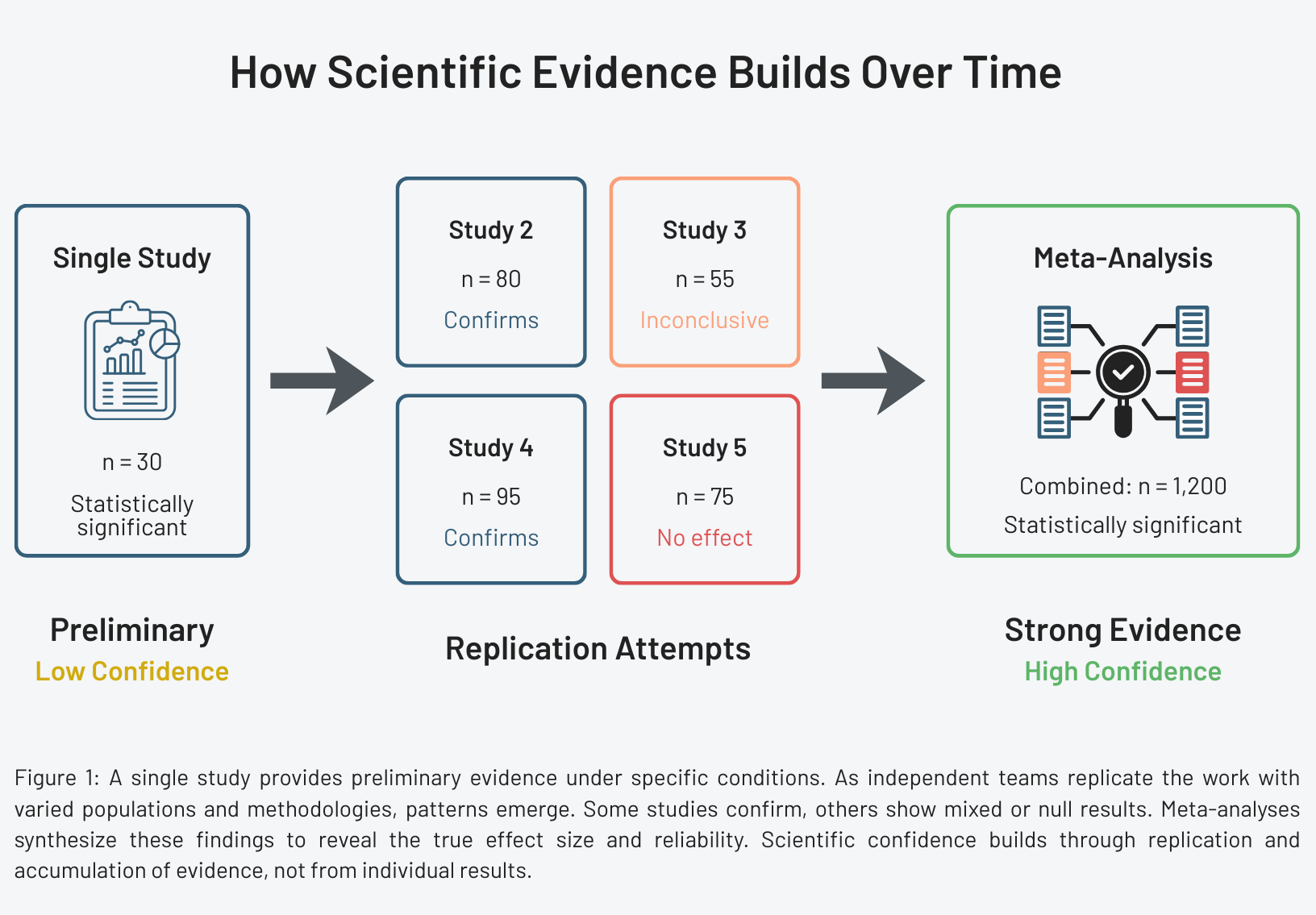
Science advances through repetition and accumulation of evidence. Once results can be replicated across different subjects, methodologies, and research teams, they become convincing (Figure 1). When evidence converges rather than diverges, a clearer conclusion emerges.
This is where systematic reviews and meta-analyses come in. These approaches evaluate all available evidence on a particular question, paying attention to study quality, potential bias, and variability across findings. They are slower and less glamorous but deeply informative.
Why early studies get so much attention
If single studies are rarely enough, why do they often dominate public conversation? Part of the reason is structural. Science and media reward novelty. Journals, universities, and press outlets are incentivized to highlight new findings rather than what has been confirmed repeatedly. Earlier results are easier to frame as discoveries, even when they’re preliminary.
There’s also a human element. People tend to prefer certainty. Nuanced conclusions are harder to communicate and harder to sit with. A single study can feel like an answer, even when it isn’t one yet. In an environment that incentivizes speed, there’s real pressure to oversimplify findings.
A concrete example
Consider a study suggesting that drinking a particular green juice improves energy levels. The study compares 25 college students who drink the juice every day for four weeks to 25 students who don’t. It reports a statistically significant increase in self-reported energy in the treatment group. This is an interesting finding—but what does it actually tell us?
We can say that in this specific group, under these specific conditions, an effect was observed. We cannot know whether the same effect would appear in older adults, people with chronic fatigue, or individuals with different diets or activity levels. We don’t know if the effect persists beyond four weeks. We also don’t know whether the reported energy increase is caused by the juice itself or by some other factor that wasn’t controlled for.
To answer those questions, we’d need more studies: larger sample sizes, different populations, longer timeframes, and investigations into potential mechanisms. Until that evidence accumulates, the most accurate conclusion is ‘promising, but preliminary.’
What one study can do
Even though individual studies are rarely enough on their own, they’re still essential. Every body of evidence begins with a first observation. Single studies point research in productive directions. They lay the groundwork for future investigations.
Problems arise when a single study is overstated—when the first step is presented as the last. Recognizing that difference allows us to engage with research more accurately, without dismissing it or overstating its implications.
How to read new research more carefully
When encountering claims based on a single study, a few questions can provide useful context:
- Is this the first study of its kind, or is it part of a larger body of work?
- How large was the sample size, and who was included?
- What outcomes were measured, and over what timeframe?
- Have other studies reached similar conclusions?
Shifting focus from what was found to how confident we can be in what was found leads to a more realistic understanding of scientific progress.
Why this matters
When individual studies are treated as definitive, the iterative nature of science is lost. Progress gets misrepresented as a series of breakthroughs rather than a slow, careful process. Recognizing that one study is almost never enough doesn’t make science weaker—it makes it more honest. Scientific knowledge is strongest when it’s understood as cumulative and always open to revision.
References
- Why Most Published Research Findings Are False, PLoS Medicine
- Estimating the reproducibility of psychological science, Science
- Predictive power of statistical significance, World Journal of Methodology
- Power failure: why small sample size undermines the reliability of neuroscience, Nature Reviews Neuroscience