
What 'Backed by Science' Really Means
'Backed by science' sounds reassuring—but what does it actually mean? A closer look at how scientific evidence is built, interpreted, and often oversimplified.

The phrase everywhere right now
‘Backed by science’ is one of the most pervasive phrases in marketing today. From supplements and skincare to fitness programs and diet plans, it appears everywhere—a metaphorical stamp of approval meant to evoke trust and legitimacy. The phrase suggests that the work has already been done for us: questions asked, evidence gathered, and a clear conclusion reached. In reality, ‘backed by science’ can mean many different things, ranging from decades of rigorous, replicated research to a single small study. The gap between how the phrase sounds and what the science actually supports can be wide, leaving plenty of room for confusion.
Why it works
There’s a reason the phrase works so well: science carries authority, and it has earned our trust. Modern medicine, technology, and public health exist because careful research works. When something is described as ‘backed by science,’ it feels like a safe choice—especially in contexts where uncertainty can be uncomfortable, such as health decisions.
Most people don’t have the time or the training to dissect every claim they encounter. Scientific literature is dense, jargon-heavy, and often hidden behind paywalls. When the information seems overwhelming, it’s instinctive to rely on authoritative-sounding language as a shortcut.
What science actually is
The core issue with the phrase ‘backed by science’ is that science is neither static nor final. It’s a process—and usually a slow one. Research studies are designed to answer specific questions under controlled conditions. Each study contributes a small piece of knowledge to a larger body of work, and conclusions are revised as new evidence emerges. Science doesn’t arrive at 'proof' in the way the term is commonly understood.
Replication plays a critical role in this process. Large-scale efforts to reproduce published findings have shown that initial results often do not replicate as expected—not because the original research was poorly conducted, but because early findings can be incomplete or sensitive to context. When a single study is summarized without this framework and treated as universal truth, the iterative nature of science disappears, leaving an impression of certainty that the evidence doesn’t fully support.
What ‘backed by science’ can mean
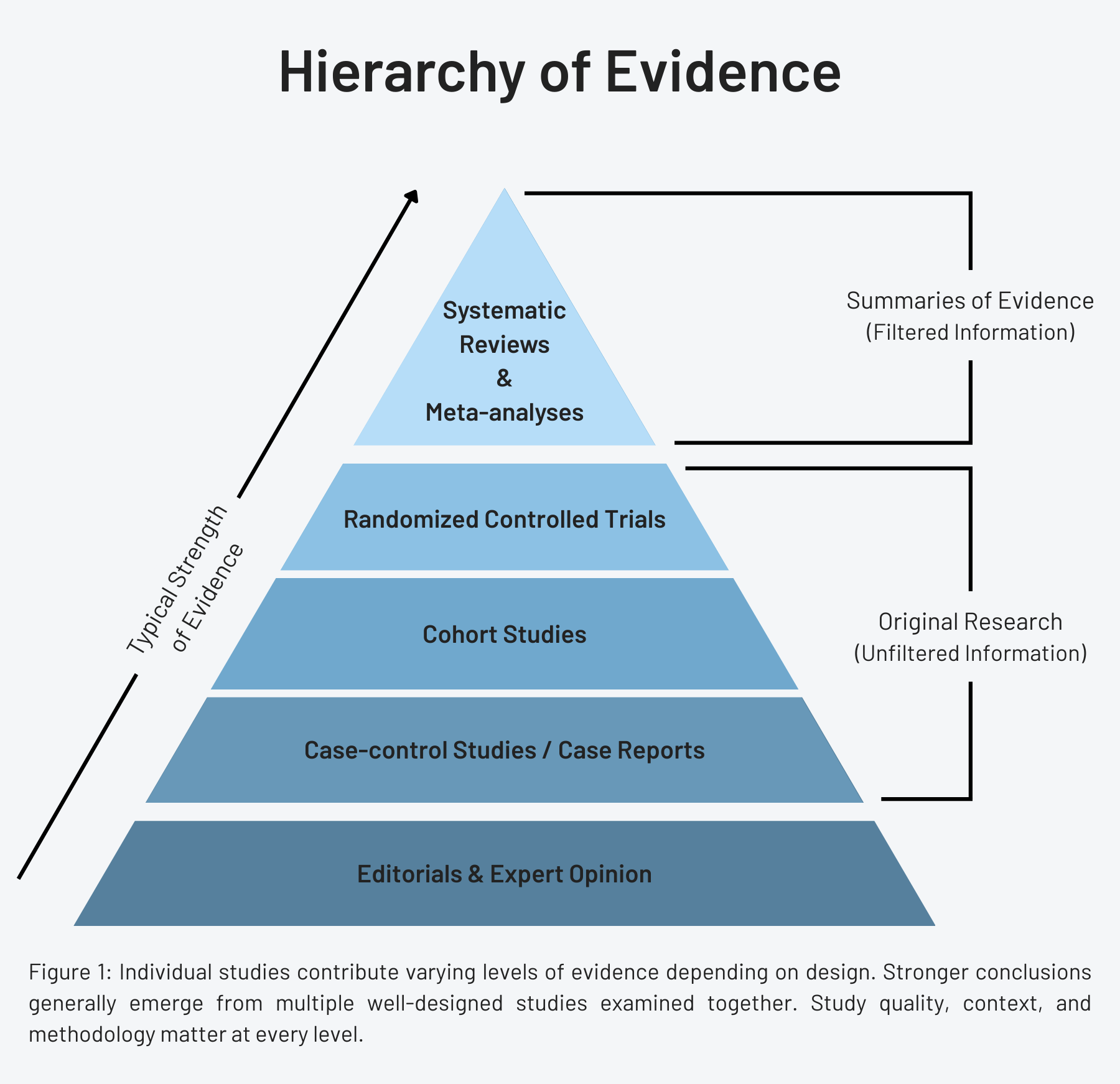
In practice, ‘backed by science’ can refer to a wide range of evidence, but not all evidence carries the same weight. In scientific research, evidence typically exists on a hierarchy (Figure 1). Different study designs offer different levels of confidence, with systematic reviews and meta-analyses providing stronger evidence than single exploratory studies. Most claims fall somewhere in between. A product might be ‘backed’ by a single observational study, a trial with 20 participants, or research conducted in animals. These studies aren’t inherently invalid, but they’re incomplete. When marketing language doesn’t acknowledge where a claim lands within the evidence hierarchy, very different kinds of evidence can end up sounding interchangeable.
What gets left out
When we see the phrase ‘backed by science’, we often assume that a product has been tested and proven to work. The details that would help us evaluate that assumption are rarely mentioned—and they’re usually critical. Common omissions include sample size, population studied, which outcomes were actually measured, and potential conflicts of interest. Without this information, we’re left with reassurance rather than understanding. The phrase ‘backed by science’ becomes a substitute for transparency.
A closer look
Consider a supplement marketed with the claim that it ‘supports metabolism’ and is ‘backed by science.’ What does that actually mean?
In practice, this claim may refer to a single study conducted in animals or a small group of humans over a short period. The study might measure a biomarker associated with metabolism. Results could show that subjects who received the supplement had statistically significant changes in that biomarker compared to a control group.
This finding sounds promising. However, an important piece of information was left out: those changes didn’t correspond with measurable improvements in energy, sleep, or overall metabolic health. Participants didn’t report feeling different, and their body composition didn’t shift. The effect, while statistically detectable, wasn’t clinically meaningful.
Many studies measure biomarkers rather than health outcomes, and while these measures can provide useful data early on, they don’t always translate into real-world benefits. The research itself isn’t invalid—it simply supports a much narrower conclusion than the marketing implies.
What it doesn’t mean
Just because something is described as ‘backed by science’ doesn’t mean it’s proven forever, works for everyone, or is without risk. When we assume those things to be true, we’re asking science to do something it was never designed to do.
How to read it more carefully
When encountering claims that are 'backed by science,' asking a few questions can make all the difference:
- Which science is being referenced?
- Who was studied?
- Which outcomes were actually measured?
- How strong is the overall evidence?
- Who funded the research?
Answers to these questions can provide clarity and help us make more informed decisions.
Why this matters
When scientific language is used loosely, the consequences aren't always immediately obvious, but they accumulate over time. Vague phrases like ‘backed by science’ blur the line between evidence and certainty. Overstated claims can create unrealistic expectations, and when those claims are later contradicted or refined, people feel misled. Over time, skepticism toward individual products can turn into skepticism toward science itself.
Precision in scientific language may feel less exciting than bold claims, but it’s essential for clarity and trust. Saying ‘this study suggests a potential benefit in a small sample’ is less sensational than saying ‘backed by science,’ but it’s more honest. Exaggeration might benefit a few in the short term, but it undermines the credibility of science in the long run—and that hurts everyone.
The methods matter
Science is most powerful when uncertainty is acknowledged rather than hidden. The strength of scientific evidence lies not in how confidently it can be marketed, but in how carefully it’s gathered, interpreted, and revised over time. When we pay attention to those details, we’re better equipped to understand what the evidence can—and can’t—tell us. We become harder to mislead and easier to inform. That’s why the methods matter.
References
- Investigating the Replicability of Preclinical Cancer Biology, eLife
- Hierarchy of Evidence Within the Medical Literature, Hospital Pediatrics
- Evidence Hierarchy: What is the Best Evidence?, University of Minnesota
- Biomarkers and Surrogate Endpoints In Clinical Trials, Statistics in Medicine
- Associations Between Surrogate Markers and Clinical Outcomes for Nononcologic Chronic Disease Treatments, JAMA